Most hotels don't lose revenue because of a lack of bookings, they lose it to small, invisible operational gaps: a room sold twice on two different OTAs, a rate that's ₹500 cheaper on one platform than another, or a listing that shows "sold out" when the room is actually free. A channel manager exists specifically to close those gaps.
What a Channel Manager Actually Does
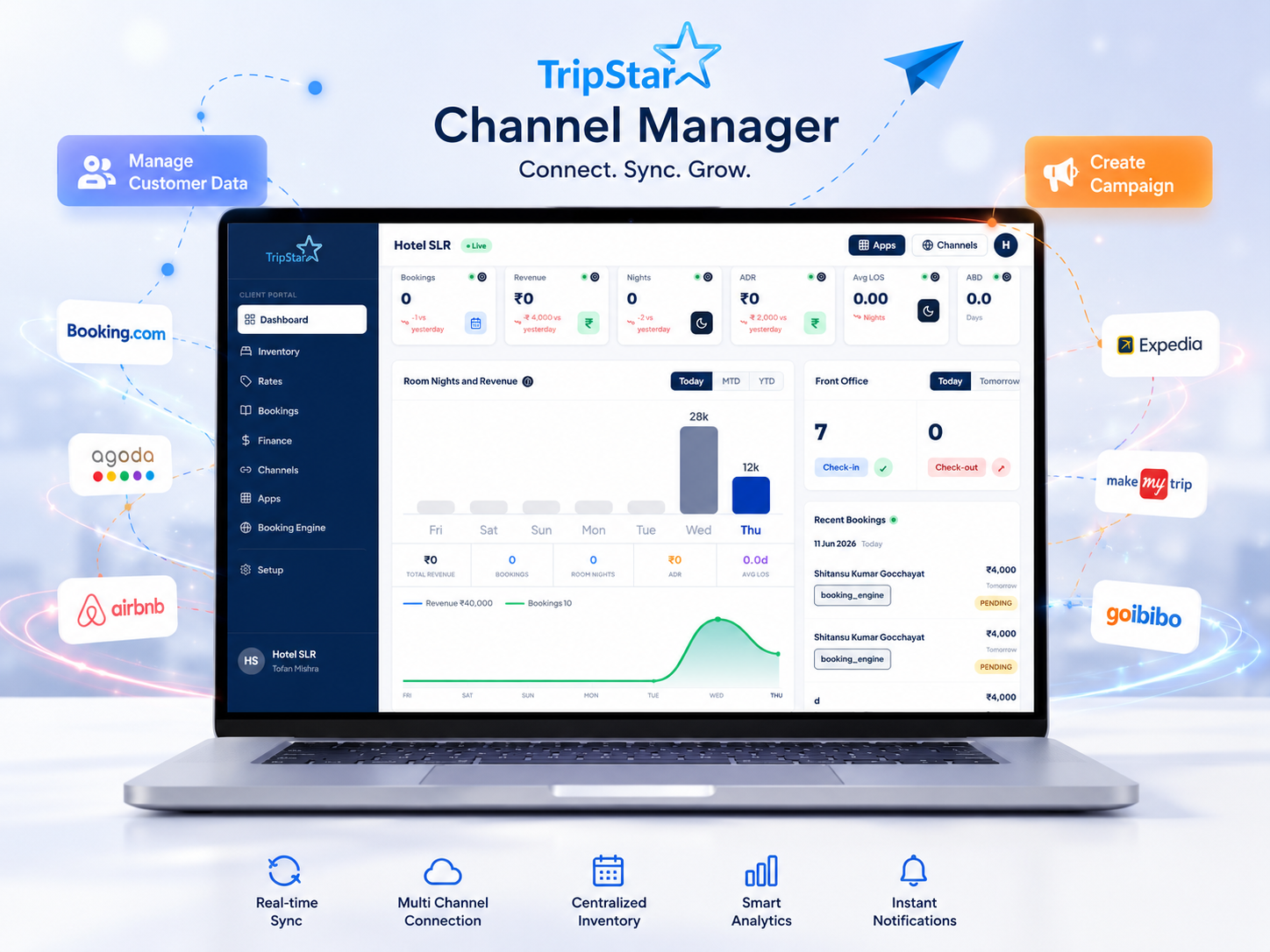
A channel manager connects your hotel to every OTA, Booking.com, MakeMyTrip, Agoda, Expedia, Airbnb and more, from a single dashboard. Update a rate or block a room once, and it syncs everywhere automatically, in real time.
1. It Eliminates Double Bookings
When availability isn't synced live across channels, two guests can book the same room on two different platforms. A channel manager updates availability the moment a booking comes in, closing that room everywhere else instantly.
2. It Keeps Pricing Consistent
Rate parity issues, where your price differs across OTAs, damage guest trust and can violate OTA partner agreements. A channel manager pushes rate changes to every connected platform at once, so pricing stays accurate everywhere without manual re-entry.
3. It Saves Hours of Manual Work
Updating five or more OTA extranets by hand, every day, is not a sustainable process for any front desk team. Automating that sync frees staff to focus on guests instead of spreadsheets and login screens.
4. It Improves Your Ranking on OTAs
OTAs reward properties that maintain accurate, responsive listings with better search placement. Fewer cancellations from overbooking and more consistent availability both signal reliability to the platform's ranking algorithm.
5. It Connects Cleanly to Your Booking Engine and PMS
The real value shows up when your channel manager, booking engine and property management system talk to each other. Bookings from every OTA, plus your own website, land in one calendar, no manual cross-checking required.
Ready to be live on every major OTA without the manual work?
See Tripstar Channel Manager →Who Needs This
Any property listed on more than one OTA, budget hotels, resorts, guesthouses, homestays, service apartments and hotel groups, benefits from a channel manager. The more channels you sell on, the more manual risk you're carrying without one.
A channel manager doesn't just save time, it directly protects revenue that would otherwise be lost to overbookings, rate mismatches and missed availability updates.
Getting Started
If you're currently managing more than two OTA extranets manually, that's usually the clearest sign it's time to connect a channel manager. Pair it with active OTA management for the biggest impact on occupancy.
Read next: OTA Management for Hotels: The Complete 2026 Guide.

Tripstar Team
We build the channel manager, PMS and booking engine software behind hundreds of live hotel accounts across India.